
Specialist Services / Orthopaedics & Traumatology
Orthopaedics & Traumatology
Diagnosis and treatment of bone, joint and sports injuries — from conservative care and physiotherapy to joint replacement and minimally invasive orthopaedic surgery.
ABOUT
About Orthopaedics & Traumatology
Orthopaedics & Traumatology deals with problems of bones, joints and soft tissues (muscle, tendon, ligament, nerve, blood vessel, intervertebral disc) of the upper limbs, lower limbs and spine. Patients range from neonates to the elderly, covering congenital, developmental, traumatic, degenerative and neoplastic conditions. Care usually combines surgical and non-surgical approaches to restore movement, function and quality of life.

Scope of services
Common symptoms
- Pain: e.g. back or neck pain
- Swelling: e.g. swollen finger joints
- Stiffness: e.g. stiff shoulder
- Weakness: e.g. leg weakness
- Deformity: e.g. bowlegs
Common conditions
Common orthopaedic injury
- Fractures: e.g. wrist, ankle, clavicle
- Sprain
Sports injury
- Anterior cruciate ligament (ACL) tear (Related video)
- Meniscus tear (Related video)
- Rotator cuff tear
- Joint dislocation
Joint
- Frozen shoulder and capsulitis (Related video)
- Osteoarthritis of knee
- Osteoarthritis of knee (degenerative) (Related video)
- Osteoarthritis of hip
- Osteophytes (bone spurs)
Hand, wrist and elbow
- Carpal tunnel syndrome
- Ganglion
- De Quervain syndrome (mommy thumb / mommy wrist)
- Trigger finger (Related video)
- Tennis elbow
- Golfer’s elbow
Leg, ankle and foot
- Clubfoot
- Flat foot
- High-arched foot
- Hallux valgus (bunion) (Related video)
- Plantar fasciitis (Related video)
- Intoeing
- Out-toeing
- Bowlegs
- Knock knees
- Leg length discrepancy
- Diabetic foot and Charcot foot
Spine
- Prolapsed intervertebral disc
- Cervical spinal stenosis
- Lumbar spinal stenosis
- Sciatica (Related video)
Musculoskeletal tumour
- Benign tumour
- Primary bone cancer: osteosarcoma, chondrosarcoma etc.
- Secondary bone cancer (metastasis)
Paediatric orthopaedics
- Lower limb and gait abnormalities in children (please refer to common leg, ankle and foot problems)
- Developmental dysplasia of the hip (DDH)
- Bone fractures in children
- Scoliosis
- Torticollis
- Osteoporosis (Related video)
Investigation & diagnosis
- X-ray
- Ultrasound (USG) scan
- Computerised tomography (CT) scan
- Magnetic resonance imaging (MRI) scan
- Dual-energy X-ray absorptiometry (DXA)
- Bone biopsy (check for cancer)
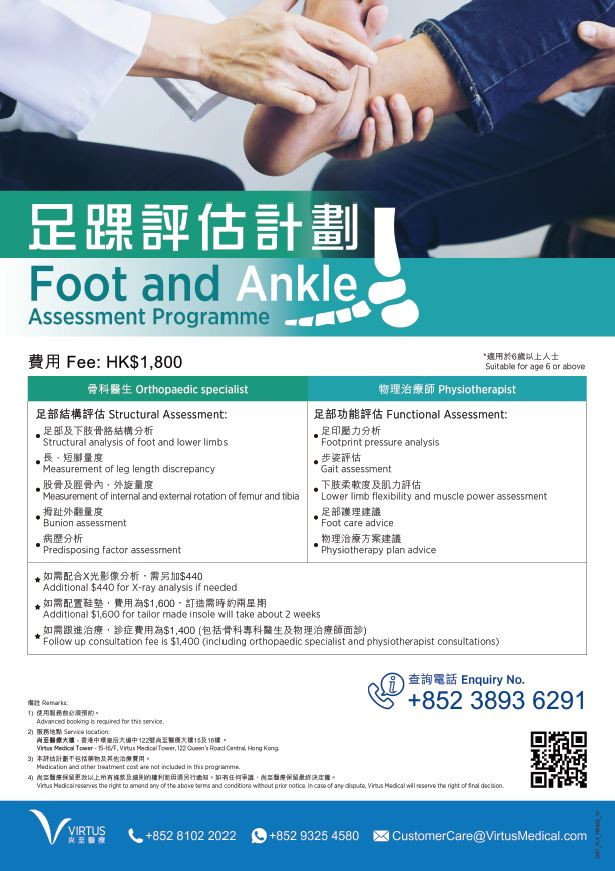
- Foot and ankle assessment
Orthopaedic treatment
Non-surgical treatment
Treatment for orthopaedic patients could be non-surgical such as drug treatment and physiotherapy. Both are good for inflammation control at different body parts due to traumatic or degenerative causes. Injection treatment has been used for decades in Orthopaedics, e.g. viscosupplement injection to joint and steroid injection to inflamed soft tissue. Physiotherapy also plays an important role in the rehabilitation of orthopaedic patients from right after injury to the post-operative period.
Orthopaedic rehabilitation services we provide include but are not limited to:
- Manual therapy
- Electrotherapy
- Extracorporeal shockwave therapy
- Computerised muscle strength testing and training
- LPG M6 endermotherapy
- Exercise therapy
- Clinical Pilates
- Whole-body vibration therapy
- Return-to-sports rehabilitation
- Postoperative rehabilitation
- Prescription custom orthotics
- Treatment modality rental
- Domiciliary care services
Surgical treatment
Traditional orthopaedic surgery usually involves open surgical procedures, but a large amount of surgical treatment can now be done with small wounds and minimally invasive technique, particularly over the knee, shoulder, wrist, foot and spine.
Orthopaedic surgical treatments we provide include but are not limited to:
Arthroscopy
During an arthroscopic procedure, an arthroscope — a tube-like instrument with a light and camera at one end — is inserted into the joint through a small incision to help the orthopaedic surgeon visualise, diagnose and treat problems inside. E.g.: knee arthroscopy, shoulder arthroscopy, ankle arthroscopy, elbow arthroscopy, wrist arthroscopy.
Fusion
It can be understood as a welding process that fuses two or more bones together with the use of bone grafts or other implants to help them heal into one single solid bone. E.g.: spinal fusion, ankle fusion.
Internal fixation
A surgical procedure to stabilise a bone fracture. Broken bones are repositioned to normal alignment and held together by implants such as nails, screws, wires and plates. E.g.: fracture fixation.
Replacement
Partial or total replacement of an inflamed, degenerated and damaged joint or intervertebral disc with an artificial implant. E.g.: knee replacement, hip replacement, intervertebral disc replacement.
Osteotomy
A surgical procedure that corrects any bone deformity by cutting, reshaping and repositioning the bone. E.g.: Scarf osteotomy (hallux valgus correction), knee osteotomy, spinal osteotomy.
Soft tissue repair and reconstruction
A surgical procedure to repair damaged soft tissues such as tendons and cartilages. If reconstruction is required, the orthopaedic surgeon may perform a grafting or use an artificial implant to replace the damaged tissue. E.g.: meniscus repair / artificial meniscus reconstruction, ACL reconstruction, rotator cuff repair.
Decompression surgery
Surgical removal of bones or tissues that are pressing on the nerve to relieve pressure. E.g.: lumbar decompression surgery, cervical decompression surgery, carpal tunnel release surgery, cubital tunnel release surgery.
Musculoskeletal tumour removal
In a wide excision, the surgeon may need to perform amputation to remove all of the cancer. A limb-salvage surgery, on the other hand, provides a chance to keep the limb by removing only the malignant tumour and replacing the diseased bone with a graft or an implant.
Minimally invasive surgery
Spine surgery
- Transforaminal nerve root injection
- Discogram
- Minimally invasive discectomy
- Minimally invasive intervertebral fusion
Shoulder arthroscopy
- Acromioplasty
- Capsular release
- Shoulder labral repair
- Rotator cuff repair
Elbow arthroscopy
- Scar release
- Removal of loose body
Wrist arthroscopy
- Ligament and TFCC repair
- Ganglion excision
Hip arthroscopy
- Hip labral repair
- Osteoplasty
Knee arthroscopy
- Ligament reconstruction and repair
- Meniscus repair and partial meniscectomy
- Cartilage repair
- Retinacular release
- Popliteal cyst excision
Ankle arthroscopy
- Synovectomy
- Removal of loose body and osteophyte
Fracture fixation
- Intramedullary nail
Musculoskeletal tumour
- US or CT guided biopsy
Navigation and robotic surgery
- Hip replacement
- Knee replacement
TEAM
Our team


Service brochures
EDUCATION
Health articles

Four ways to prevent fractures
Almost everyone faces osteoporosis risk — higher-risk groups include women, those with prior fractures, family history, and long-term steroid use.

Wrist pain — hidden risks
Causes include acute trauma, old sprains, sports overload and chronic strain; specialist assessment and imaging are advised.

Trigger finger — fascial release without stitches
Often from repetitive finger use; minimally invasive fascial release can be done under local anaesthetic in day clinic.
MEDIA
Interviews
ACL tear
Minimally invasive arthroscopic ACL repair plus physiotherapy to help restore activity.
Osteoarthritis of the knee
May lead to bowlegs — symptoms, causes and whether supplements help.
Osteoporosis
Raises fall and fracture risk — four practical ways to reduce fracture chance.
Frequently Asked Questions
Our Orthopaedics & Traumatology service provides outpatient assessment and follow-up, with investigations or multidisciplinary coordination as clinically indicated. The exact scope of care is determined by the attending physician.
Consider a consultation if you have persistent or recurrent symptoms, an existing diagnosis requiring specialist follow-up, or a referral from your family doctor.
Submit a request via the booking page, call +852 8102 2022, or select a doctor from the name-card / care team pages before booking.
Please bring identification, a referral letter (if any), previous investigation reports or imaging, and a medication list to support assessment.
Clinic location depends on the doctor’s schedule and may be in Central, Tsim Sha Tsui or another centre. Our team will confirm the venue when arranging your appointment.